
Mutualism: The Successor to Capitalism—and the End of Open-Loop Thinking

Updated: Sep 4, 2025

Reading time: ~5 minutes
Capitalism, as we know it, runs on open loops.
Extract resources. Capture attention. Accumulate wealth. Repeat.
It’s an engine that assumes infinite inputs—whether that’s natural resources, human energy, or social trust. For 200 years, it worked astonishingly well. It fueled industrial revolutions, lifted billions from poverty, and built the infrastructure of our modern world.
But here’s the problem: open loops always break.
Eventually, the resources run out. The trust erodes. The humans get burned out. And the system collapses under the weight of its own extraction.
We see the symptoms everywhere: climate destabilization, political extremism, leadership scandals, and a generation of professionals sprinting on treadmills that never stop.
The solution isn’t to burn it all down or retreat into nostalgia. It’s to close the loops—to create systems where value circulates instead of leaks.
I call that successor model Mutualism.
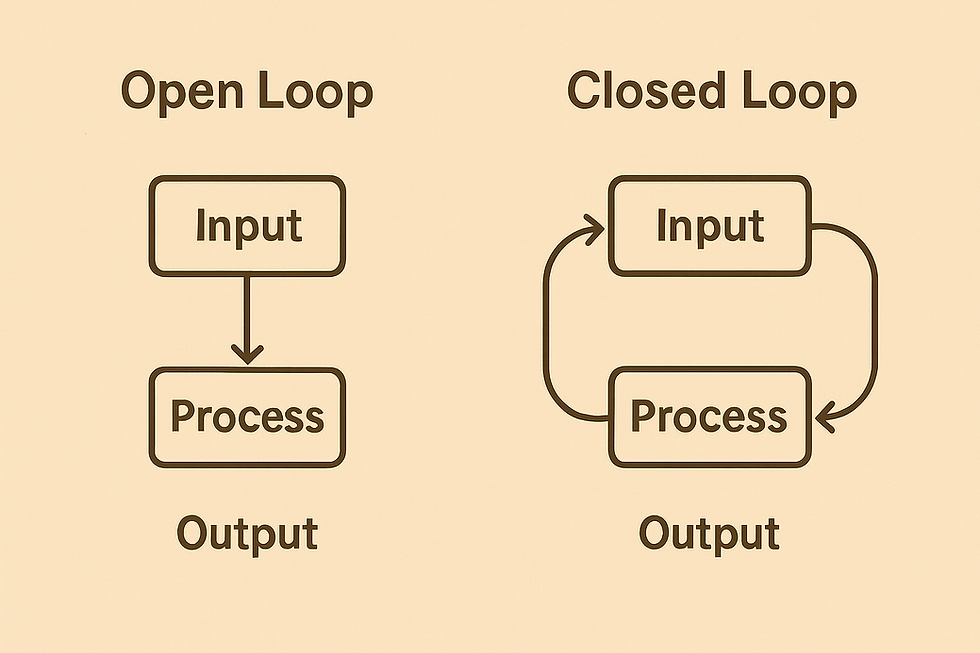
Open Loops vs. Closed Loops: A Mental Model for the Future
Before we get to Mutualism, we need to define the loops.
Open-Loop Thinking: “I must accumulate all the wealth and resources.”
Extractive, zero-sum, short-term.
Think: strip-mining the earth, VC-fueled blitzscaling, or the CEO who treats people as disposable.
Closed-Loop Thinking: “I want to leave the world better than I found it.”
Regenerative, compounding, mutually beneficial.
Think: the circular economy, open-source communities, or the Gates Foundation’s approach to global health.
Closed loops don’t just feel better—they perform better over time. They create resilience, trust, and self-sustaining growth instead of boom-and-bust cycles.
Mutualism is closed-loop capitalism.
It takes the engine of human ambition and innovation, but redirects it to circulate value instead of just extracting it. Unlike European social democracy, it isn’t bound to a single nation-state or cultural monoculture. Mutualism can thrive in a distributed, global, multi-ethnic world because it’s not about redistribution from a central authority—it’s about structural reciprocity baked into how we operate.
Part 1: Climate and Sustainability – Closing the Planetary Loop
Climate change is the ultimate open-loop problem.
Industrial capitalism treated the atmosphere like an infinite landfill. We extracted fossil fuels, burned them, and ignored the exhaust. The loop stayed open because nobody had to pay the real cost.
Mutualism in climate looks different:
Circular supply chains where products are built to be disassembled and reused.
Ecosystem credits where businesses reinvest in the natural systems they depend on.
Distributed accountability where communities can see and measure the loops they’re part of.
Closed loops turn sustainability from a moral chore into a strategic advantage. Companies that design regenerative loops will outlast the ones still playing extraction-and-PR theater.
Part 2: Capitalism and Wealth – From Hoarding to Circulating
Traditional capitalism idolizes the accumulator. Billionaires are treated as demigods for hoarding resources, even when their wealth stagnates in trusts and shell corporations.
Open-loop wealth creates instability because hoarded capital is dead capital. It doesn’t circulate. It doesn’t compound socially.
Mutualist wealth flips the script:
Profits are reinvested in employees, communities, and ecosystems that generate future opportunities.
Philanthropy evolves from optics to embedded circulation—think catalytic funds, perpetual grants, or profit-sharing ecosystems.
Wealthy actors measure their legacy in the systems they reinforce, not the commas in their accounts.
History will remember which billionaires left the world better—and which ones just played zero-sum Monopoly on a burning planet.
Part 3: Leadership and Governance – Loops at the Human Scale
Open-loop leadership is easy to spot:
The founder who burns through talent in the name of speed.
The politician who extracts trust for power, leaving institutions weaker than they found them.
The manager who treats employees like expendable inputs instead of co-creators.
The short-term results can look impressive. IPOs, viral campaigns, or election wins. But the loops are leaking. Teams burn out. Reputations tank. Trust evaporates.
Closed-loop leadership—Mutualist leadership—compounds instead of depletes:
Teams grow stronger under your guidance.
Knowledge and culture circulate, instead of disappearing when one person exits.
Success multiplies because the system itself is more resilient.
The best leaders are loop architects, not extractors.
Part 4: Personal Development – Stop Living Open Loop
Open-loop thinking doesn’t just break companies—it breaks people.
I’ve watched brilliant operators flame out because their personal loops were wide open:
Chasing endless credentials and titles for external validation.
Trading sleep, health, and relationships for temporary wins.
Treating every interaction as a transaction.
Closed-loop personal growth—Mutualist living—is the antidote:
Skill loops – Learn things that compound into your current ecosystem instead of chasing random badges.
Energy loops – Protect your health and mental clarity as the fuel for everything else.
Relationship loops – Invest in the few connections that circulate support and opportunity.
When your life loops are closed, progress compounds naturally. You stop sprinting for validation and start building a self-sustaining engine.
Part 5: Personal Relationships – Spotting Open-Loop Humans
Your network is a reflection of the loops you tolerate.
Open-loop humans are extractors:
Shady CEOs who borrow your credibility and vanish at the first sign of accountability.
Grifters, outrage merchants, or bad-faith actors who turn every interaction into a transaction.
Chronic “takers” who never close the loop with follow-through, gratitude, or reciprocity.
Closed-loop humans—Mutualist relationships—are compounding assets:
Wins for them reinforce wins for you.
Energy and trust circulate naturally.
They leave you better than they found you.
A single Mutualist relationship is worth more than ten transactional ones. They’re the human expression of the system we’re trying to build.
The Mutualist Future
Mutualism isn’t utopian. It’s pragmatic.
Systems with closed loops are more resilient, more ethical, and more profitable in the long run than systems that burn through everything in reach. Whether it’s climate, wealth, leadership, or your personal life, the same principle holds:
Open loops collapse. Closed loops compound.
The next era of human progress won’t belong to the extractors—it will belong to the architects of circulation.
If this resonates, explore more of my writing at Numbers & Letters or reach out for a consultation to discuss Mutualist strategy for your organization. The sooner we start closing loops, the longer we all get to play the game.
If you're interested in exploring more on this topic, here are a few sources we recommend that dive deeper into similar ideas:
Disclaimer/Full Disclosure (You made it!): This blog post was generated with the assistance of AI, with N&L human oversight ensuring accuracy and insight. The thoughts and opinions expressed are our own.


Comments